White Label vs Full Source Code Crypto Exchange Software: Which Is Better for Your Business?
October 22, 2026
Launching a cryptocurrency exchange is more accessible today than it was a decade ago. Businesses no longer need to develop every trading component from scratch. Instead, they can choose between white label cryptocurrency exchange software, hosted exchange platforms, and complete crypto exchange source code solutions.
However, choosing the right technology model is one of the most important decisions when building a digital asset trading business.
Should you use a white label cryptocurrency exchange that is managed by a third-party provider? Or should you invest in a self-hosted platform with complete source code access?
In this guide, we compare both approaches, explain their advantages and limitations, and explore how businesses can build a scalable cryptocurrency exchange while maintaining control over their technology.
What Is White Label Cryptocurrency Exchange Software?
White label cryptocurrency exchange software is a prebuilt trading platform that businesses can customize and launch under their own brand.
Instead of developing a cryptocurrency exchange from the beginning, companies use an existing software solution with essential features such as trading dashboards, user management, order books, wallets, and administrative controls.
Many white label providers operate through a Software-as-a-Service (SaaS) business model.
In this arrangement, the provider may control the underlying infrastructure, maintain the backend technology, and charge recurring licensing or subscription fees.
Common benefits of white label exchange software include:
- Faster initial deployment
- Reduced internal development requirements
- Prebuilt trading interfaces
- Access to existing exchange functionality
- Technical maintenance from the provider
However, the level of customization and technical ownership depends heavily on the licensing agreement.
Some white label providers restrict access to source code, databases, backend services, and infrastructure configuration.
For businesses planning to build a long-term cryptocurrency exchange brand, these limitations can become important.
What Is Full Source Code Crypto Exchange Software?
Full source code cryptocurrency exchange software provides businesses with access to the underlying application code used to operate their trading platform.
Rather than depending entirely on a vendor-managed infrastructure, companies can deploy the software on their own servers, customize the technology, and build additional features.
A complete crypto exchange platform typically includes a matching engine, trading interface, multi-currency wallets, administrative dashboard, user authentication, API integrations, and compliance-related functionality.
With commercial source-code access, developers can modify the platform according to their licensing rights.
This approach is especially attractive to fintech businesses, blockchain startups, and enterprises that want greater technical independence.
For example, MyCrypto Exchange provides commercial cryptocurrency exchange software with complete source-code access, self-hosted deployment options, and customizable trading infrastructure.
Its platform includes spot trading components, wallet infrastructure, liquidity integrations, P2P trading, administrative tools, and mobile application support.
White Label vs Full Source Code Cryptocurrency Exchange: Key Differences
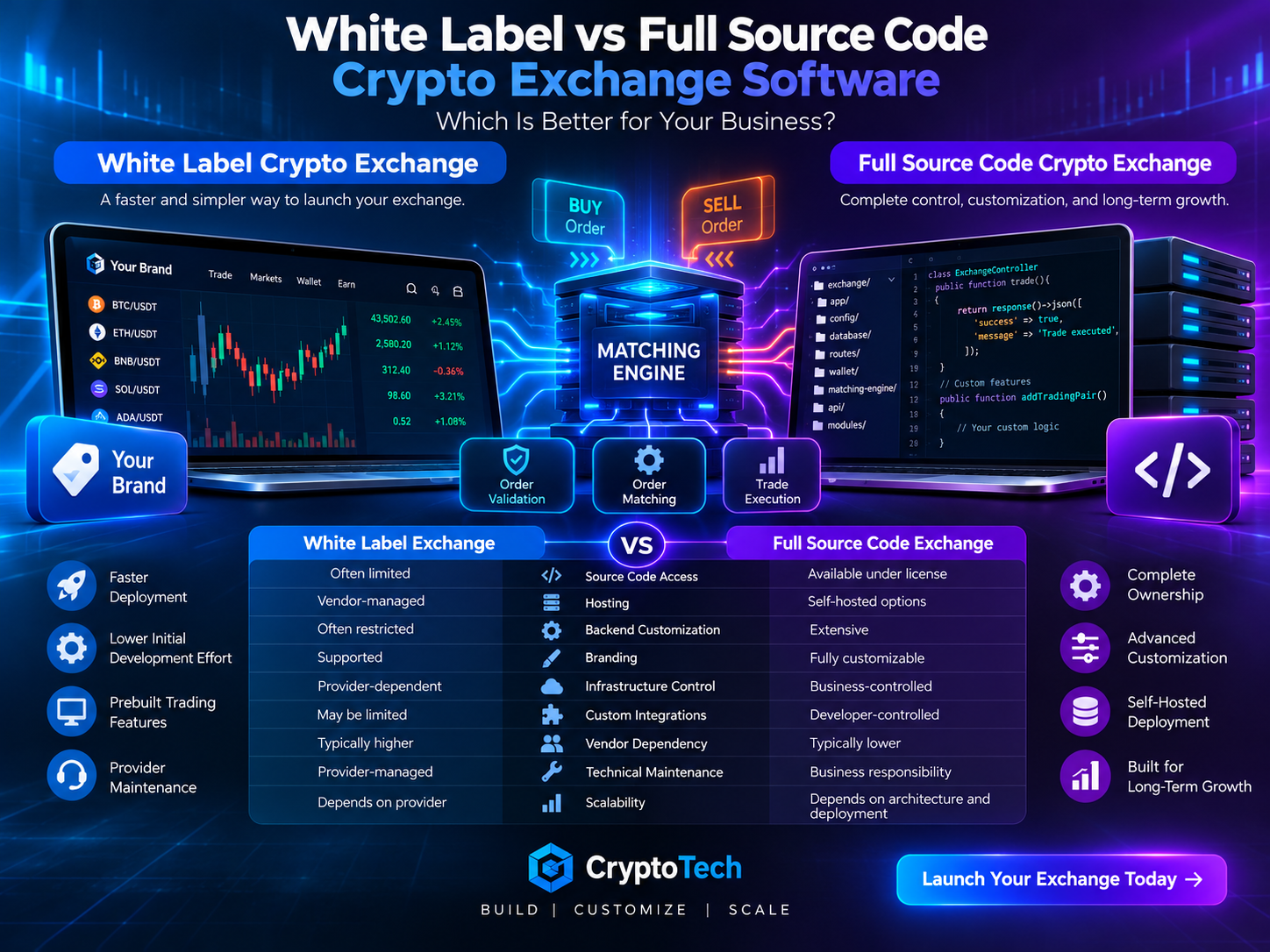
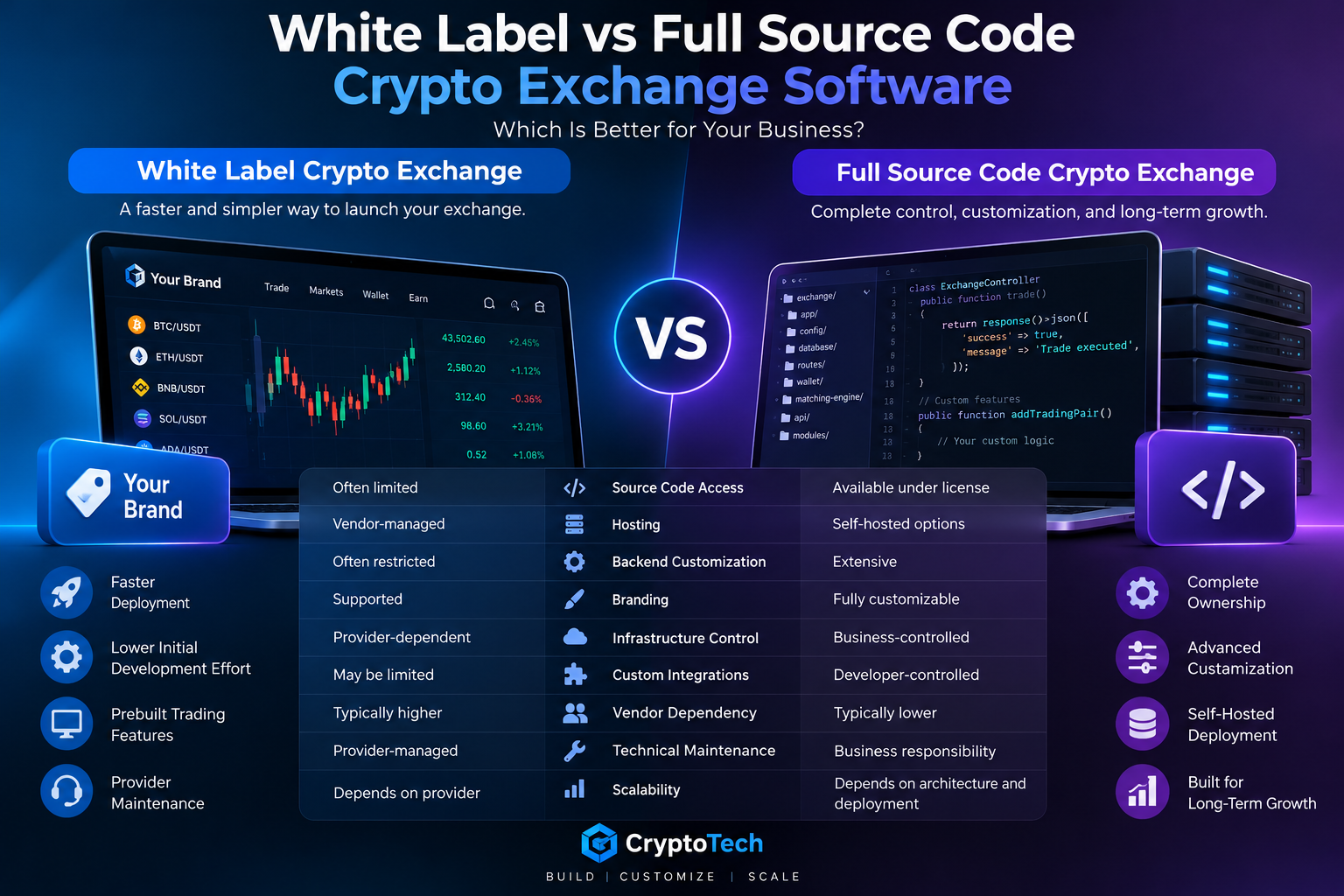
| Feature | Traditional Hosted White Label | Full Source Code |
|---|---|---|
| Source Code Access | Often limited | Available under license |
| Hosting | Vendor-managed | Self-hosted options |
| Backend Customization | Often restricted | Extensive |
| Branding | Usually supported | Fully customizable |
| Infrastructure Control | Provider-dependent | Business-controlled |
| Custom Integrations | May be limited | Developer-controlled |
| Vendor Dependency | Typically higher | Typically lower |
| Technical Maintenance | Often provider-managed | Business responsibility |
| Scalability | Depends on provider | Depends on architecture and deployment |
Both models can support a successful exchange business. The right choice depends on the company’s budget, technical resources, target market, and long-term strategy.
1. Technology Ownership and Business Independence
One of the biggest differences between hosted white label platforms and full source code solutions is control over the technology.
With a traditional hosted exchange, businesses may rely on the provider for software updates, infrastructure management, integrations, and feature development.
If the provider changes its pricing, policies, or available services, the exchange operator may have limited alternatives.
A full source code solution can reduce this dependency.
Businesses can maintain their own infrastructure, hire independent developers, create new modules, and decide which integrations to implement.
Source-code access does not necessarily mean unrestricted intellectual property ownership. Businesses should review their licensing agreements carefully.
Nevertheless, having access to the application code can provide substantially more operational flexibility.
2. Cryptocurrency Exchange Customization
Every cryptocurrency exchange has different requirements.
Some platforms focus on spot trading, while others prioritize P2P transactions, institutional liquidity, regional payment methods, or specialized digital assets.
White label platforms typically support changes to branding, colors, logos, and selected interface elements.
However, modifying backend business logic may require provider approval or may not be supported.
With full source code, development teams can implement custom functionality such as:
- New cryptocurrency trading pairs
- Custom trading fees and commission structures
- Additional payment gateways
- Regional KYC and identity verification integrations
- Advanced administrative workflows
- Custom wallet integrations
- Proprietary API endpoints
- Specialized trading interfaces
- New blockchain network support
This flexibility is particularly valuable for businesses operating in competitive or specialized markets.
3. Matching Engine Performance and Scalability
The matching engine is one of the most important components of a centralized cryptocurrency exchange.
It processes incoming buy and sell orders, manages the order book, and matches compatible trades according to predefined rules.
As trading activity increases, matching engine performance becomes increasingly important.
Exchange operators should evaluate several technical characteristics, including order-processing throughput, execution latency, data consistency, recovery behavior, and infrastructure requirements.
A self-hosted platform gives businesses more control over deployment architecture and performance optimization.
MyCrypto offers trading infrastructure with matching engine implementations designed for different technical requirements, including Laravel-based and Rust-based options.
According to MyCrypto’s published product information, its platform offers matching engine capacity of up to 250,000 orders per second. Actual performance should be evaluated under the intended deployment conditions and workload.
Businesses selecting cryptocurrency exchange software should request technical documentation and conduct their own performance tests before production deployment.
4. Security and Cryptocurrency Wallet Infrastructure
Security is critical for any platform handling customer accounts, cryptocurrency deposits, and digital asset withdrawals.
A cryptocurrency exchange requires protection across multiple systems, including user authentication, APIs, wallets, administrative permissions, and infrastructure.
Important security controls may include:
- Two-factor authentication
- Encryption of sensitive information
- Withdrawal authorization workflows
- API rate limiting
- DDoS mitigation
- Role-based administrator permissions
- Hot and cold wallet management
- Monitoring and suspicious activity detection
- Independent security audits
Hosted solutions may handle some infrastructure security responsibilities on behalf of the customer.
Self-hosted solutions provide more flexibility over security architecture but also require the operator to manage deployment, access controls, patching, and ongoing monitoring.
Full source-code availability can make independent code review and security customization possible.
However, purchasing source code does not automatically guarantee that an exchange is secure. Professional auditing, operational procedures, and continued security maintenance remain essential.
5. Cryptocurrency Exchange Liquidity Integration
Liquidity plays a major role in the trading experience.
An exchange with limited market depth may experience wider spreads, price volatility, and difficulty executing larger orders.
New cryptocurrency exchanges often connect to external liquidity providers, market makers, or established trading venues.
Depending on the platform, liquidity infrastructure may include external exchange APIs, pricing feeds, order routing, and liquidity aggregation.
Businesses using full source code can customize how their platform communicates with supported external services.
MyCrypto supports liquidity connectivity and integrations designed to connect trading platforms with external exchanges, market makers, and other liquidity providers.
However, software integration alone does not guarantee sufficient liquidity. Operators must establish appropriate commercial relationships and configure their trading infrastructure.
6. Long-Term Costs: Subscription vs Source Code Licensing
The initial purchase price is only one component of the total cost of operating a cryptocurrency exchange.
Businesses should consider development, hosting, maintenance, security, compliance, and third-party service expenses.
A hosted white label provider may charge setup fees, monthly subscriptions, transaction-based fees, or additional integration costs.
A full source code solution may require a larger initial investment but can provide more flexibility in managing ongoing technology expenses.
Costs associated with a self-hosted exchange may include:
- Commercial software licensing
- Cloud servers or dedicated infrastructure
- Software development and customization
- Wallet and blockchain infrastructure
- Security auditing
- KYC and AML service providers
- Liquidity connectivity
- Technical support and maintenance
The most economical model depends on usage, the licensing structure, customization requirements, and the company’s ability to manage technical operations.
Businesses should compare total cost of ownership over several years rather than focusing exclusively on initial software pricing.
7. Why Businesses Choose MyCrypto Exchange Software
MyCrypto is designed for businesses seeking a customizable cryptocurrency exchange platform without having to develop all core components from scratch.
The software combines trading infrastructure, wallet management, administrative tools, and external integrations into a commercial solution.
Key MyCrypto capabilities include:
Complete Source Code Access: Customize application functionality, user interfaces, APIs, and backend workflows according to the applicable commercial license.
Self-Hosted Deployment: Deploy the platform on infrastructure controlled by your business.
High-Performance Matching Engine: Support cryptocurrency trading with configurable order processing and matching infrastructure.
Multi-Currency Wallets: Manage deposits, withdrawals, cryptocurrency balances, and blockchain integrations.
KYC and AML Integrations: Connect identity verification and compliance service providers based on regulatory and operational needs.
P2P Trading: Support peer-to-peer cryptocurrency marketplaces with configurable trading workflows.
REST and WebSocket APIs: Integrate trading applications, liquidity providers, payment systems, and external services.
Mobile Applications: Extend the exchange experience to supported iOS and Android applications.
MyCrypto states that its software supports more than 1,000 digital assets and has served over 300 customers worldwide.
Businesses can explore the technical capabilities and licensing model through the MyCrypto Crypto Exchange Source Code page.
Which Cryptocurrency Exchange Software Model Should You Choose?
A hosted white label platform may be suitable for businesses that want to launch a relatively standardized exchange and prefer outsourcing infrastructure management.
It can also be useful for teams without extensive internal development resources.
A full source code solution may be more appropriate for companies that require advanced customization, private infrastructure, specialized integrations, and greater independence from software vendors.
Before making a decision, businesses should evaluate their development capabilities, regulatory obligations, security requirements, expected trading volume, and long-term technology strategy.
Frequently Asked Questions
Is white label cryptocurrency exchange software the same as full source code software?
No. White label usually describes software that businesses can rebrand and offer under their own identity. Full source code describes access to the application’s underlying code. Some white label solutions also provide source-code access, so the two models are not necessarily mutually exclusive.
Can I launch a cryptocurrency exchange using purchased source code?
Yes. Commercial exchange software can provide a foundation for launching a trading platform. However, production deployment also requires appropriate infrastructure, security controls, operational preparation, liquidity arrangements, and compliance with applicable laws.
Is MyCrypto open-source software?
No. MyCrypto offers proprietary commercial cryptocurrency exchange software with source-code access under its applicable licensing terms.
Can I host MyCrypto on my own server?
Yes. MyCrypto supports self-hosted deployment, allowing businesses to operate the software on infrastructure they control.
Does MyCrypto support custom cryptocurrencies and payment integrations?
MyCrypto supports the integration of additional digital assets, blockchain networks, payment providers, and external services according to technical and business requirements.
Conclusion
Choosing between traditional white label cryptocurrency exchange software and a full source code solution involves more than comparing features and prices.
Businesses must consider technology independence, long-term customization, operational responsibility, security, and scalability.
Hosted platforms can simplify technical operations, while complete source-code solutions can offer greater control over infrastructure and development.
For businesses planning to build a customizable trading platform under their own brand, MyCrypto offers a commercial cryptocurrency exchange foundation with source-code access and self-hosted deployment capabilities.
Ready to build your own cryptocurrency exchange?
Explore MyCrypto cryptocurrency exchange software and discover how you can launch a trading platform with complete source-code access, customizable infrastructure, and long-term technology flexibility.