Crypto Exchange Matching Engine: How It Works and Why Performance Matters
October 22, 2026
Every cryptocurrency trade depends on a critical piece of technology operating behind the scenes: the crypto exchange matching engine.
Whether a trader purchases Bitcoin, sells Ethereum, or places a limit order for another digital asset, the matching engine determines how compatible buy and sell orders are executed.
For businesses developing a centralized cryptocurrency exchange (CEX), selecting the right matching engine architecture is essential. The engine affects trading speed, market efficiency, order execution, and the overall user experience.
In this guide, we explain how cryptocurrency matching engines work, the technologies behind them, their performance requirements, and how businesses can integrate a matching engine into a complete cryptocurrency exchange platform.
What Is a Crypto Exchange Matching Engine?
A crypto exchange matching engine is a software system responsible for matching buy and sell orders submitted by traders.
It is one of the core components of a centralized cryptocurrency exchange.
When users submit trading orders, the matching engine evaluates available orders in the market and determines whether a transaction can occur.
For example, imagine two traders participating in the BTC/USDT market:
- Trader A wants to buy 1 BTC for $70,000.
- Trader B wants to sell 1 BTC for $70,000.
If their orders are compatible and satisfy the exchange’s matching rules, the matching engine can execute the trade.
Although the concept sounds straightforward, real cryptocurrency exchanges may receive thousands of order submissions, cancellations, and modifications within short periods.
A reliable matching engine must process these events efficiently while maintaining accurate market data and consistent trading records.
How Does a Cryptocurrency Matching Engine Work?
A typical cryptocurrency matching engine follows several important steps.
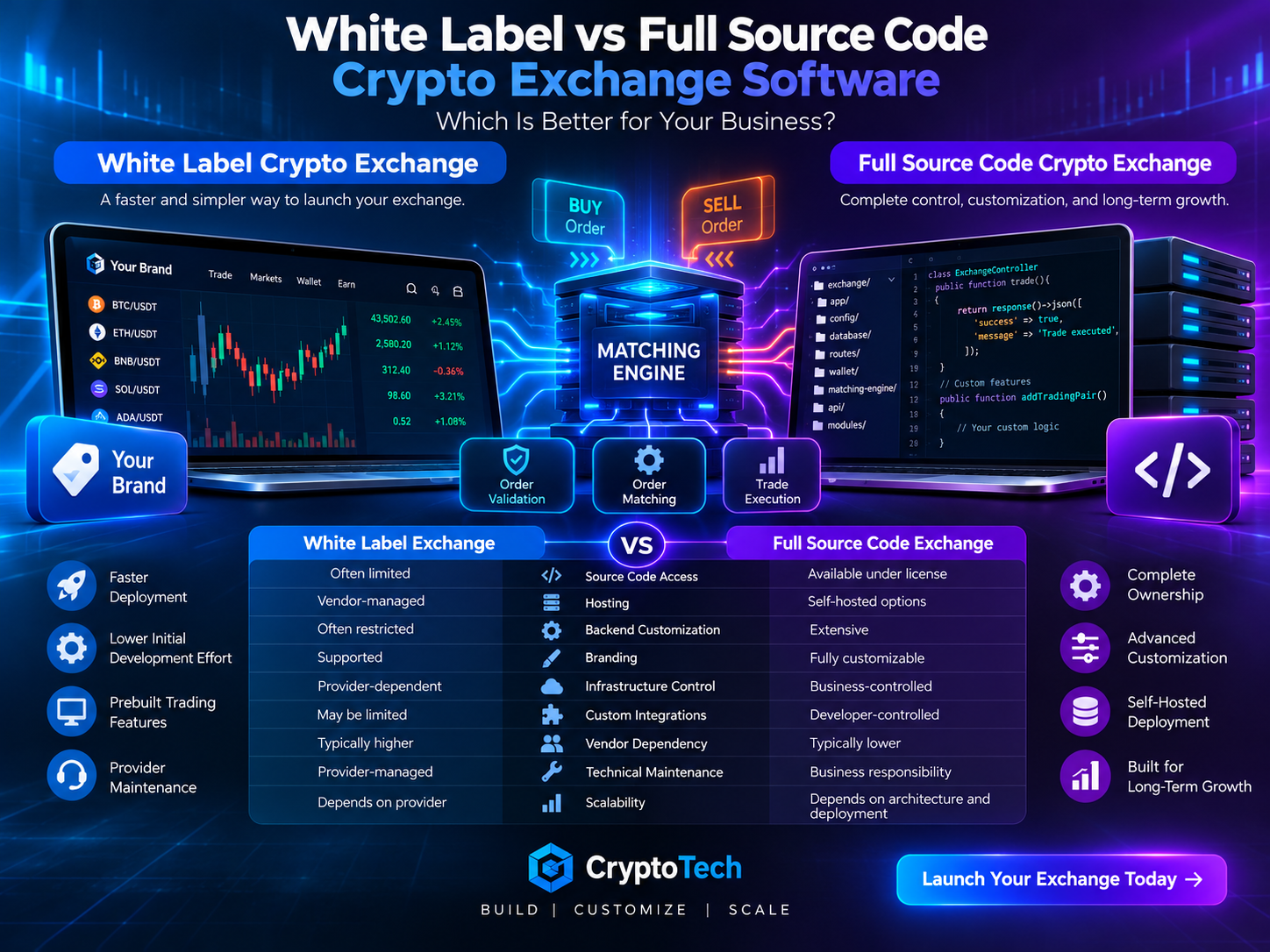
Step 1: Receiving Trading Orders
A trader submits a buy or sell order through a web application, mobile application, or trading API.
The order contains details such as the trading pair, order type, quantity, and price, where applicable.
Step 2: Validating the Order
Before the order reaches the matching engine, the exchange checks whether it meets the platform’s trading requirements.
Validation may include account permissions, available balances, minimum trade amounts, supported markets, and price precision.
Step 3: Adding Orders to the Order Book
If the submitted order cannot be executed immediately, eligible remaining quantity may be stored in the order book.
The order book organizes active buy and sell orders for a particular trading pair.
Buy orders are called bids, while sell orders are called asks.
Step 4: Matching Compatible Orders
The matching engine continuously checks incoming orders against available opposite-side orders.
For example, a new buy order can match an existing sell order if the prices are compatible.
The engine determines execution price and quantity according to the exchange’s trading rules.
Step 5: Executing Trades and Updating Balances
When compatible orders are matched, the trading system records the executed transaction.
The exchange then updates the relevant trading balances, reserved funds, order statuses, and transaction history.
Step 6: Broadcasting Market Updates
After execution, the exchange distributes updated market information through its trading interface and APIs.
This information can include executed trades, order book changes, price updates, and account-specific order status notifications.
Real-time communication technologies such as WebSockets help trading platforms deliver these updates efficiently.
Understanding the Crypto Exchange Order Book
The order book is closely connected to the matching engine.
It displays active buy and sell orders for a specific cryptocurrency market.
Consider the following simplified BTC/USDT order book.
| Buy Orders (Bids) | Sell Orders (Asks) |
|---|---|
| $69,980 — 0.8 BTC | $70,000 — 0.5 BTC |
| $69,970 — 1.2 BTC | $70,010 — 1.0 BTC |
| $69,950 — 2.0 BTC | $70,020 — 1.5 BTC |
The highest bid is $69,980, while the lowest ask is $70,000.
The difference between these prices is known as the bid-ask spread.
When a compatible incoming order arrives, the matching engine executes against eligible resting orders according to the exchange’s matching algorithm.
Efficient order book management is particularly important when markets experience heavy activity.
Types of Orders Supported by Matching Engines
Different cryptocurrency exchanges support different order types.
Two of the most common are market orders and limit orders.
Market Orders
A market order instructs the exchange to buy or sell an asset immediately against available liquidity.
Market orders prioritize execution rather than a specific guaranteed price.
If insufficient liquidity exists at the best available price, a market order may execute across multiple price levels, resulting in slippage.
Limit Orders
A limit order allows traders to specify the maximum price they are willing to pay when buying or the minimum price they are willing to accept when selling.
If no compatible orders are available, the limit order may remain open until it is matched, canceled, or otherwise expires.
Advanced Order Types
Depending on the exchange implementation, additional order types may include stop orders, stop-limit orders, immediate-or-cancel orders, fill-or-kill orders, and post-only orders.
Each requires additional execution rules, validation, and order lifecycle handling.
What Is Price-Time Priority in Crypto Trading?
One of the most widely used matching algorithms is price-time priority, also known as FIFO matching.
Under this model, orders with better prices receive priority.
When multiple orders have the same price, the order entered earlier receives priority.
For example, suppose three traders place sell orders at $70,000.
If Trader A submits an eligible order before Trader B and Trader C, Trader A generally receives execution priority under FIFO rules.
This helps establish predictable trading behavior.
Some trading venues implement alternative allocation methods, including pro-rata matching.
The appropriate algorithm depends on the market structure and exchange requirements.
Why Matching Engine Speed and Latency Matter
Performance directly affects trading execution and exchange reliability.
Two important metrics are throughput and latency.
Throughput measures how many orders or events a system can process within a given period, commonly expressed as orders per second.
Latency measures how long an individual operation takes to complete.
A matching engine may process a large number of orders per second while still experiencing high latency under certain conditions.
For this reason, both measurements are important.
A well-designed cryptocurrency exchange should aim for:
- Consistent order processing under high trading loads
- Predictable execution latency
- Accurate order book updates
- Reliable trade recording
- Efficient market data distribution
- Recovery mechanisms following service interruptions
- Controlled resource utilization
Performance testing should examine realistic workloads, including bursts of new orders, cancellations, and market volatility.
Building a High-Performance Cryptocurrency Matching Engine
The architecture of a matching engine influences its speed, reliability, and scalability.
Several engineering approaches can improve performance.
In-Memory Order Books
Maintaining active order books in memory can reduce the need for repeated database queries during matching operations.
Persistent storage and recovery mechanisms are still necessary to protect system integrity.
Efficient Data Structures
Matching engines frequently use optimized data structures to organize prices and manage available orders.
The appropriate structure depends on the matching algorithm, supported order operations, and memory requirements.
Asynchronous Processing
Asynchronous messaging can help separate market data distribution, notifications, analytics, and other secondary operations from latency-sensitive trading execution.
Persistent Event Logs
Durable transaction logs can support recovery, reconciliation, auditing, and deterministic replay.
Scalable Deployment Architecture
As an exchange expands, different markets or supporting services may be distributed across infrastructure components.
However, individual order books must preserve the ordering and consistency required by the matching algorithm.
Scaling a matching engine is therefore more complex than simply adding servers.
Laravel vs Rust for Cryptocurrency Matching Engines
Technology selection is an important consideration when designing cryptocurrency exchange infrastructure.
Laravel and Rust can serve different roles within a trading platform.
Laravel-Based Exchange Infrastructure
Laravel is a PHP framework suitable for developing exchange applications, administrative systems, user management, REST APIs, and business workflows.
Its development ecosystem makes it useful for building maintainable, customizable trading platforms.
Laravel-based systems can support order processing and trading functionality, depending on their architecture and performance requirements.
Rust-Based Matching Engine
Rust is a systems programming language commonly selected for performance-sensitive applications.
Its compiled execution model, memory safety guarantees, and concurrency capabilities make it an attractive option for dedicated matching engine development.
Rust can be especially useful when an exchange requires tight latency control and high event-processing throughput.
Which Technology Should You Choose?
The decision depends on trading volume, architectural complexity, development resources, and infrastructure requirements.
A practical approach may combine a Laravel-based exchange application with a separate high-performance matching engine service.
The exchange interface, accounts, wallets, and administration can remain within the application architecture while the dedicated matching engine handles latency-sensitive order execution.
MyCrypto Cryptocurrency Exchange Matching Engine
Businesses building a cryptocurrency exchange do not necessarily need to develop every trading component from scratch.
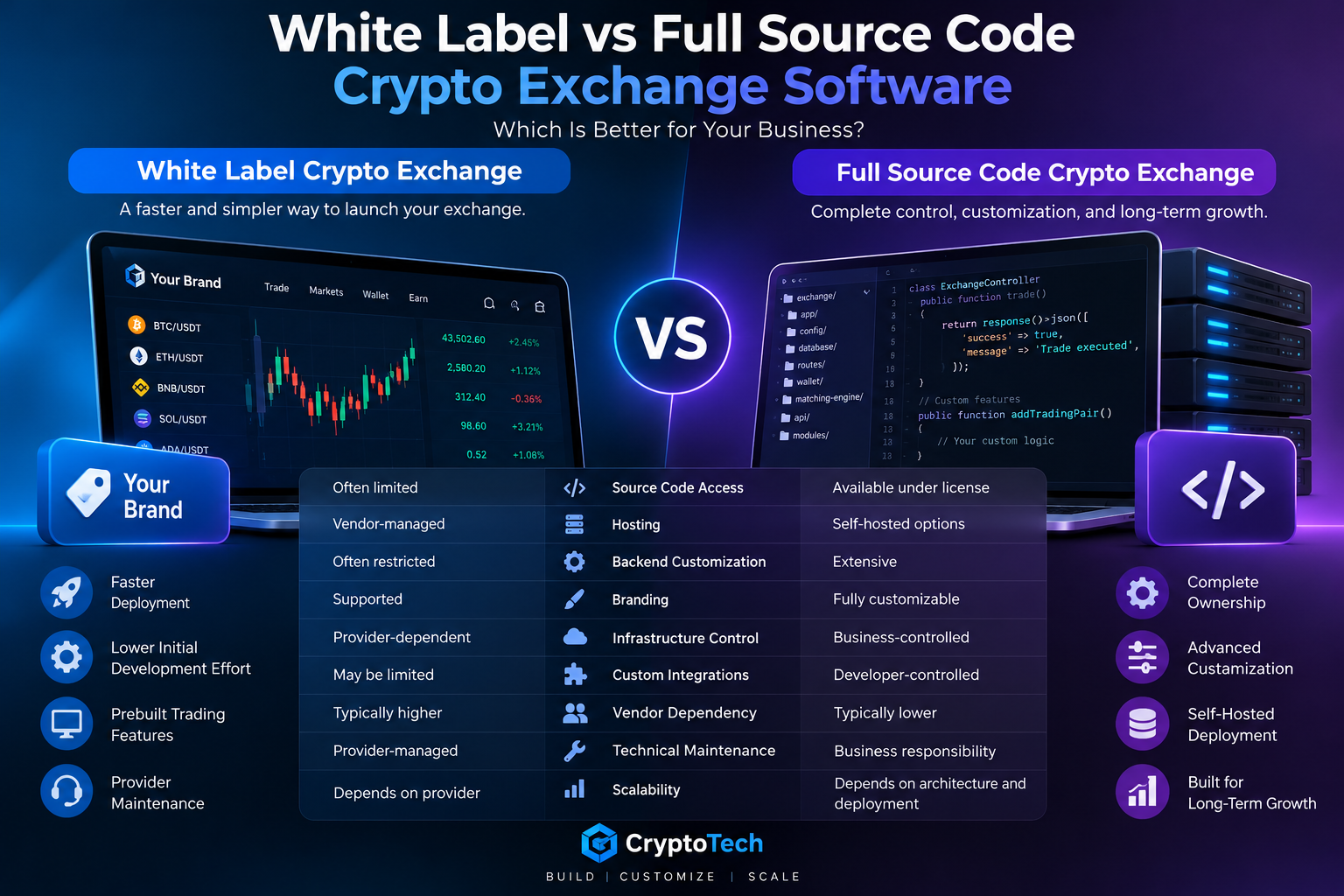
MyCrypto Exchange offers commercial cryptocurrency exchange software with matching engine functionality, customizable trading infrastructure, and source-code access according to the selected license.
MyCrypto’s platform supports:
- Cryptocurrency spot trading
- Market and limit orders
- Real-time order books
- Multiple trading pairs
- Configurable trading fees
- REST and WebSocket APIs
- Cryptocurrency wallet infrastructure
- External liquidity connectivity
- Self-hosted deployment
MyCrypto’s standard product pages describe matching engine capacity of up to 250,000 orders per second, depending on configuration and workload.
The company also offers a dedicated Rust-based low-latency matching engine for its Enterprise offering, with a separately advertised higher-capacity specification.
These are vendor-published capacity figures rather than independently verified guarantees. Businesses should evaluate the relevant package and request performance benchmarks under their expected trading conditions.
To explore the full architecture, visit the MyMyCryptonology stack page.
Matching Engine vs Liquidity Provider: What’s the Difference?
Matching engines and liquidity providers perform different functions.
A matching engine determines how compatible orders are executed within the exchange.
A liquidity provider supplies or facilitates access to buy and sell interest.
An exchange may have a fast matching engine but still offer a poor trading experience if its markets lack sufficient liquidity.
For example, an exchange with low market depth may experience wide spreads and substantial slippage even when orders are processed quickly.
This is why exchange operators often integrate external exchanges, market makers, or liquidity aggregation services.
MyCrypto supports external liquidity connectivity, allowing businesses to incorporate compatible liquidity providers into their exchange infrastructure.
The availability of liquidity, pricing, and execution quality depends on the agreements and configuration established by the exchange operator.
Security and Reliability of Crypto Trading Engines
Performance alone is not sufficient for an exchange operating with customer assets.
A cryptocurrency matching engine must also maintain accurate execution records and consistent system state.
Important engineering safeguards include:
- Order validation and authorization
- Prevention of duplicate execution
- Consistent balance reservations
- Durable trade records
- Controlled order cancellation
- Recovery after unexpected interruptions
- Monitoring and operational alerting
- Audit logs and reconciliation
- API authentication and rate limiting
Independent security reviews and realistic failure testing are important before launching a production trading environment.
Exchange security also extends beyond the matching engine to wallet custody, user authentication, infrastructure, employee permissions, and regulatory compliance.
How to Choose a Matching Engine for Your Cryptocurrency Exchange
When evaluating cryptocurrency exchange technology, businesses should examine several factors.
Performance: Determine the throughput and latency requirements of your target markets.
Reliability: Understand how the system handles interruptions, recovery, and transaction consistency.
Customization: Verify whether trading rules, fees, integrations, and order types can be modified.
Source Code: Confirm what application components are provided and what rights the commercial license grants.
Liquidity Integration: Evaluate compatibility with external trading venues and market makers.
Maintenance: Consider the technical resources required for monitoring, updates, and infrastructure management.
Scalability: Review how the software supports additional markets, users, and trading activity.
A successful exchange requires the right combination of execution technology, liquidity, security, and operational planning.
Frequently Asked Questions
What does a crypto matching engine do?
A cryptocurrency matching engine processes trading orders and matches compatible buy and sell requests according to an exchange’s execution rules.
How fast should a cryptocurrency matching engine be?
The required speed depends on the exchange’s target market, expected order volume, and trading model. High-throughput systems should also be evaluated for latency consistency and reliability.
Is a matching engine the same as an order book?
No. An order book contains active buy and sell orders, while the matching engine applies the rules that determine how eligible orders are executed.
Can I build a crypto exchange without developing my own matching engine?
Yes. Businesses can use commercial cryptocurrency exchange software that includes a matching engine, provided the system meets their technical and operational requirements.
Does MyCrypto provide matching engine source code?
MyCrypto offers commercial exchange source-code access and matching engine solutions. The precise components and rights included depend on the selected package and license.
Does MyCrypto support Rust matching engines?
MyCrypto advertises a Rust-based low-latency matching engine offering for enterprise customers, alongside its broader cryptocurrency exchange software infrastructure.
Conclusion
A cryptocurrency exchange matching engine is one of the most important technologies behind a centralized trading platform.
It determines how orders are processed, how trades are executed, and how the exchange responds to changing market conditions.
For businesses building a cryptocurrency trading platform, matching engine performance should be evaluated alongside security, liquidity, reliability, and long-term customization requirements.
MyCrypto provides a commercial foundation for launching a customizable cryptocurrency exchange with integrated trading infrastructure, source-code access, wallets, APIs, and liquidity connectivity.
Build your cryptocurrency exchange with MyCrypto.
Explore MyCrypto cryptocurrency exchange software or discover its full source-code solution to learn more about launching and customizing your own trading platform.